
Arts

Celtic Art is made up of beautiful geometric shapes. It has its origins in the sculpture, carving and metalwork of the ancient Celtic peoples. Classical Celtic art is very much a product of the growth of Christianity in early Britain and Ireland when the native styles combined with Mediterranean influences brought in by Christian missionaries.
Three of the Major Design Elements of Celtic Art
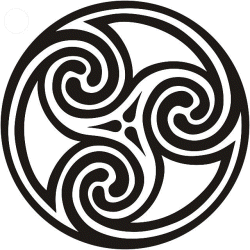 Celtic Spirals
Spirals are one of the oldest design elements in Celtic art and are believed to represent the life-force. Very typical of Celtic spirals is the three-pronged spiral or triskele and many more elaborate spirals are based on this fundamental pattern. The number three was of deep significance in Pagan Celtic religion. This worked well for early monks like Saint Patrick in Ireland who tied the already special number three into teachings about the Trinity.
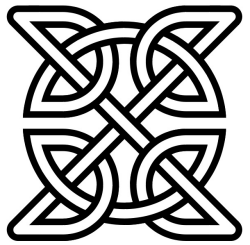 The Knotwork
Christian manuscripts were a major source of inspiration for this artform. Typical features of Celtic knotworks are the use of rounded edges and attempting to make the knotwork one continuous line.
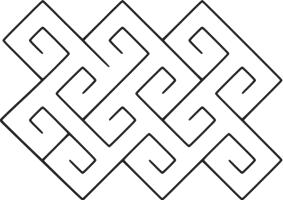 Key Patterns
These have been described as spirals in a straight line. Key patterns are also found in Mediterranean art. Celtic key patterns use the 45 degree angle so that the pattern is made up of triangle shapes.
What did they eat?
Celts ate like most other Europeans, subsisting mostly on grains supplemented by meats, fruits, and vegetables. Exactly what they ate varied by area, and Celts grew local crops. Scottish highlanders were famous for supposedly subsisting almost entirely on oats, though this was not entirely true. However, oats remain the favorite grain of Scotland, and Scottish cuisine is full of them. Potatoes serve this role in Ireland, although they were not introduced until after Columbus reached the New World.


The most famous example of food of any Celtic people is probably the Scottish haggis. Many people aren't quite clear on what a haggis is, and one survey conducted in the United States found that over half of the people they surveyed thought that the haggis was a small rodent native to Scotland. In reality, a haggis usually consists of a sheep's 'pluck' (heart, liver, windpipe and lungs), minced with onion, oatmeal, suet, spices, and salt, mixed with stock, which is traditionally boiled in the animal's stomach for about an hour.
Celtic Lifestyles

- Warriors who lost their tempers and quarrelled among themselves often
- Druids who were the religious leaders
- Farmers who looked after the land

No comments:
Post a Comment