Welcome!

 Hello everyone, Welcome to a blog on The Ancient Civilisation of The Celts*. Here you will learn a lot about The Celts. So let's get st...

Sunday, 31 January 2021

A Presentation to learn more in detail about The Celts

Click this link to open the presentation:

The Celts

Please DON'T edit this presentation without my permission.

Government System

 Among the Celtic tribes, the form of government was either monarchical or oligarchical. The Bretons were governed by several kings and chiefs, while the Caledonii had a democratic government. In Gaul and the British Isles, the power of the king was probably not very great, as they were almost certainly chosen by the people and could be easily deposed if the need arose.

Saturday, 30 January 2021

Arts, Living and food style

Arts


Celtic Art is made up of beautiful geometric shapes. It has its origins in the sculpture, carving and metalwork of the ancient Celtic peoples. Classical Celtic art is very much a product of the growth of Christianity in early Britain and Ireland when the native styles combined with Mediterranean influences brought in by Christian missionaries.
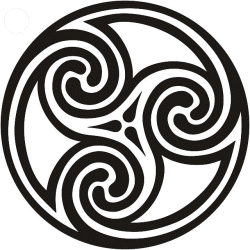
Three of the Major Design Elements of Celtic Art

Celtic spiralsCeltic Spirals

Spirals are one of the oldest design elements in Celtic art and are believed to represent the life-force.  Very typical of Celtic spirals is the three-pronged spiral or triskele and many more elaborate spirals are based on this fundamental pattern. The number three was of deep significance in Pagan Celtic religion.  This worked well for early monks like Saint Patrick in Ireland who tied the already special number three into teachings about the Trinity.
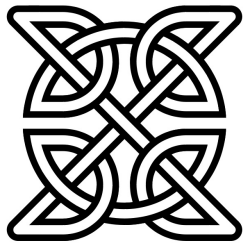
Celtic knotThe Knotwork

Christian manuscripts were a major source of inspiration for this artform. Typical features of Celtic knotworks are the use of rounded edges and attempting to make the knotwork one continuous line.
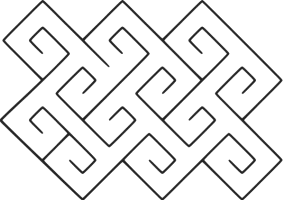
Celtic key patternsKey Patterns

These have been described as spirals in a straight line. Key patterns are also found in Mediterranean art.  Celtic key patterns use the 45 degree angle so that the pattern is made up of triangle shapes.

What did they eat?

Celts ate like most other Europeans, subsisting mostly on grains supplemented by meats, fruits, and vegetables. Exactly what they ate varied by area, and Celts grew local crops. Scottish highlanders were famous for supposedly subsisting almost entirely on oats, though this was not entirely true. However, oats remain the favorite grain of Scotland, and Scottish cuisine is full of them. Potatoes serve this role in Ireland, although they were not introduced until after Columbus reached the New World.

The Celts in Ireland farmed the land and reared cattle and sheep. In the spring, they would get milk, butter and cheese from the cattle, killing them later in the year for meat. Cattle were not only a means of food for Celts, the Celts wealth was measured in the amount of cattle they owned. One ancient Irish tale tells of Queen Maedhb (May-ev) and another rival king, and their battle over the Táin Bó Chuaille (a bull). This doesn't just show the importance of cattle in Celtic society, but also the fact that they thoroughly accepted the idea of women as leaders, unlike other societies of that time.

The most famous example of food of any Celtic people is probably the Scottish haggis. Many people aren't quite clear on what a haggis is, and one survey conducted in the United States found that over half of the people they surveyed thought that the haggis was a small rodent native to Scotland. In reality, a haggis usually consists of a sheep's 'pluck' (heart, liver, windpipe and lungs), minced with onion, oatmeal, suet, spices, and salt, mixed with stock, which is traditionally boiled in the animal's stomach for about an hour.


Celtic Lifestyles

Since the early Celts didn't read or write, we only know about their lifestyles from other people who met them

The Romans say that the Celts were split into:
  • Warriors who lost their tempers and quarrelled among themselves often
  • Druids who were the religious leaders
  • Farmers who looked after the land


Friday, 29 January 2021

Geographical structure, area of the land, name of mountains ,rivers and famous cities


Geographical structure

Ancient writers gave the name Celts to various population groups living across central Europe inland from the Mediterranean coastal areas. Most scholars agree that the Celtic culture first appeared in the Late Bronze Age in the area of the upper Danube sometime around the 13th century BCE.


Area of Land

The six territories widely considered Celtic nations are Brittany (Breizh), Cornwall (Kernow), Wales (Cymru), Scotland (Alba), Ireland (Éire) and the Isle of Man (Mannin or Ellan Vannin). In each of the six nations a Celtic language is spoken to some extent: Brittonic or Brythonic languages are spoken in Brittany, Cornwall, and Wales, while Goidelic or Gaelic languages are spoken in Scotland, Ireland, and the Isle of Man. 

Before the expansions of Ancient Rome and the Germanic and Slavic tribes, a significant part of Europe was dominated by Celts, leaving behind a legacy of Celtic cultural traits. Territories in north-western Iberia—particularly northern Portugal, Galicia, Asturias, León and Cantabria (together historically referred to as Gallaecia and Astures), covering north-central Portugal and northern Spain—are considered Celtic nations due to their culture and history. Unlike the others, however, no Celtic language has been spoken there in modern times.

Name of Mountains 

  • Ménez-Hom
  • Mont de Saint-Michel
  • Roc'h Trédudon
  • Roc'h Ruz
  • Kilmar Tor
  • Hensbarrow Beacon
  • Brown Willy
  • Snowdon
  • Pen y fan
  • Penygader
  • Tryfan
  • Glyder Fawr
  • Carnedd Llewelyn
  • Black Mountain
  • Y Garn
  • Carnedd Dafydd
  • Aran Fawddwy
  • Glyder Fawr
  • Elidir Fawr
  • Garnedd Ugain
  • Pen yr Ole Wen
And many other mountains and hills in Wales, Brittany, Isle of Man, Ireland and Scotland

Name of Rivers

  • River Wye
  • River Severn
  • River Dee
  • River Towy
  • Afon Teifi
  • River Usk
  • River Taff
  • River Dyfi
  • River Conwy
  • River Vyrnwy
  • River Monnow
  • Adet
  • Blavet
  • Oust
  • Aven
  • River Shannon
  • River Liffey 
  • River Nore
  • River Suir
  • River Blackwater
  • River Barrow
  • River Tay 
  • River Clyde 
  • River Tweed
  • River Spey
And many other rivers in Wales, Brittany, Isle of Man, Ireland and Scotland

Names of cities


Welcome!

 Hello everyone,

Welcome to a blog on The Ancient Civilisation of The Celts*.

Here you will learn a lot about The Celts.

So let's get started...!


* Pronounced as Kelts